Encoding categorical features
This section explains the way categorical encoding can be carried out using feature_encoders.
All encoders take pandas.DataFrames as input and generate numpy.ndarrays as output.
[1]:
import matplotlib.cm

import numpy as np
import pandas as pd
import matplotlib.pyplot as plt
import matplotlib.ticker as ticker

from sklearn.model_selection import KFold
from sklearn.preprocessing import KBinsDiscretizer
from sklearn.linear_model import LinearRegression
from sklearn.metrics import mean_squared_error
from matplotlib.colors import LinearSegmentedColormap, ListedColormap

%matplotlib inline
[2]:
from feature_encoders.encode import (
    SafeOrdinalEncoder,
    SafeOneHotEncoder,
    TargetClusterEncoder,
    CategoricalEncoder
)
A plotting utility:
[3]:
def get_colors(cmap, N=None, use_index="auto"):
    if isinstance(cmap, str):
        if use_index == "auto":
            if cmap in ['Pastel1', 'Pastel2', 'Paired', 'Accent',
                        'Dark2', 'Set1', 'Set2', 'Set3',
                        'tab10', 'tab20', 'tab20b', 'tab20c']:
                use_index=True
            else:
                use_index=False
        cmap = matplotlib.cm.get_cmap(cmap)
    if not N:
        N = cmap.N
    if use_index=="auto":
        if cmap.N > 100:
            use_index=False
        elif isinstance(cmap, LinearSegmentedColormap):
            use_index=False
        elif isinstance(cmap, ListedColormap):
            use_index=True
    if use_index:
        ind = np.arange(int(N)) % cmap.N
        return cmap(ind)
    else:
        return cmap(np.linspace(0,1,N))
Load demo data
The demo data represents the energy consumption of a building.
[4]:
data = pd.read_csv('data/data.csv', parse_dates=[0], index_col=0)
data = data[~data['consumption_outlier']]
data.dtypes
[4]:
consumption            float64
holiday                 object
temperature            float64
consumption_outlier       bool
dtype: object
holiday is a categorical feature. The _novalue_ value corresponds to non-holiday observations.
[5]:
data['holiday'].value_counts()
[5]:
_novalue_                       35943
Immaculate Conception             192
Christmas Day                     192
St Stephen's Day                  192
New year                           96
Epiphany                           96
Easter Monday                      96
Liberation Day                     96
International Workers' Day         96
Republic Day                       96
Assumption of Mary to Heaven       96
All Saints Day                     96
Name: holiday, dtype: int64
SafeOrdinalEncoder
The SafeOrdinalEncoder converts categorical features into ordinal integers. This results in a single column of integers (0 to n_categories - 1) per feature. Unknown categories will be replaced using the most frequent value along each column.
It is implemented as a pipeline:
UNKNOWN_VALUE = -1

Pipeline(
    [
        (
            "select",
            sklearn.compose.ColumnTransformer(
                [("select", "passthrough", self.features_)], remainder="drop"
            ),
        ),
        (
            "encode_ordinal",
            sklearn.preprocessing.OrdinalEncoder(
                handle_unknown="use_encoded_value",
                unknown_value=self.unknown_value or UNKNOWN_VALUE,
                dtype=np.int16,
            ),
        ),
        (
            "impute_unknown",
            sklearn.impute.SimpleImputer(
                missing_values=self.unknown_value or UNKNOWN_VALUE,
                strategy="most_frequent",
            ),
        ),
    ]
)
[6]:
enc = SafeOrdinalEncoder(feature='holiday')

kf = KFold(n_splits=5, shuffle=False)

for train_index, _ in kf.split(data):
    enc = enc.fit(data.iloc[train_index])
    not_seen = np.setdiff1d(data["holiday"].unique(),
                            data.iloc[train_index]["holiday"].unique()
    )
    print(f'Holidays not seen during training {not_seen}')

    features = enc.transform(data[data['holiday'].isin(not_seen)])
    print(f'Holidays not seen during training are transformed as {np.unique(features)}')

    features = enc.transform(data[data['holiday'] == '_novalue_'])
    print(f'... and the most common value is also encoded as: {np.unique(features)}')
Holidays not seen during training ['Epiphany' 'New year']
Holidays not seen during training are transformed as [9]
... and the most common value is also encoded as: [9]
Holidays not seen during training ['Easter Monday' "International Workers' Day" 'Liberation Day']
Holidays not seen during training are transformed as [8]
... and the most common value is also encoded as: [8]
Holidays not seen during training ['Republic Day']
Holidays not seen during training are transformed as [10]
... and the most common value is also encoded as: [10]
Holidays not seen during training ['Assumption of Mary to Heaven']
Holidays not seen during training are transformed as [10]
... and the most common value is also encoded as: [10]
Holidays not seen during training ['All Saints Day']
Holidays not seen during training are transformed as [10]
... and the most common value is also encoded as: [10]
[7]:
features = SafeOrdinalEncoder(feature='holiday').fit_transform(data)
assert data['holiday'].nunique() == np.unique(features).size
By default, the SafeOrdinalEncoder considers as categorical features of type object, int, bool and category:
[8]:
enc = SafeOrdinalEncoder().fit(data)
enc.features_
[8]:
['holiday', 'consumption_outlier']
SafeOneHotEncoder
The SafeOneHotEncoder uses a SafeOrdinalEncoderto first safely encode the feature as an integer array and then a sklearn.preprocessing.OneHotEncoder to encode the features as an one-hot array:
UNKNOWN_VALUE = -1

Pipeline(
    [
        (
            "encode_ordinal",
            SafeOrdinalEncoder(
                feature=self.features_,
                unknown_value=self.unknown_value or UNKNOWN_VALUE,
            ),
        ),
        ("one_hot", sklearn.preprocessing.OneHotEncoder(drop=None, sparse=False)),
    ]
)
[9]:
enc = SafeOneHotEncoder(feature='holiday')

kf = KFold(n_splits=5, shuffle=False)

for train_index, _ in kf.split(data):
    enc = enc.fit(data.iloc[train_index])
    not_seen = np.setdiff1d(data["holiday"].unique(),
                            data.iloc[train_index]["holiday"].unique()
    )
    print(f'Holidays not seen during training {not_seen}')

    features = enc.transform(data[data['holiday'].isin(not_seen)])
    # check that it is a proper one-hot
    assert np.all(features.sum(axis=1) == 1)
    print('Holidays not seen during training have non-zero value at column: '
          f'{np.argmax(features == 1)}')

    features = enc.transform(data[data['holiday'] == '_novalue_'])
    # check that it is a proper one-hot
    assert np.all(features.sum(axis=1) == 1)
    print('... and the most common value also has non-zero value at column: '
          f'{np.argmax(features == 1)}')
Holidays not seen during training ['Epiphany' 'New year']
Holidays not seen during training have non-zero value at column: 9
... and the most common value also has non-zero value at column: 9
Holidays not seen during training ['Easter Monday' "International Workers' Day" 'Liberation Day']
Holidays not seen during training have non-zero value at column: 8
... and the most common value also has non-zero value at column: 8
Holidays not seen during training ['Republic Day']
Holidays not seen during training have non-zero value at column: 10
... and the most common value also has non-zero value at column: 10
Holidays not seen during training ['Assumption of Mary to Heaven']
Holidays not seen during training have non-zero value at column: 10
... and the most common value also has non-zero value at column: 10
Holidays not seen during training ['All Saints Day']
Holidays not seen during training have non-zero value at column: 10
... and the most common value also has non-zero value at column: 10
All encoders have a n_features_out_ property after fitting.
[10]:
enc = SafeOneHotEncoder(feature='holiday').fit(data)
assert data['holiday'].nunique() == enc.n_features_out_
TargetClusterEncoder
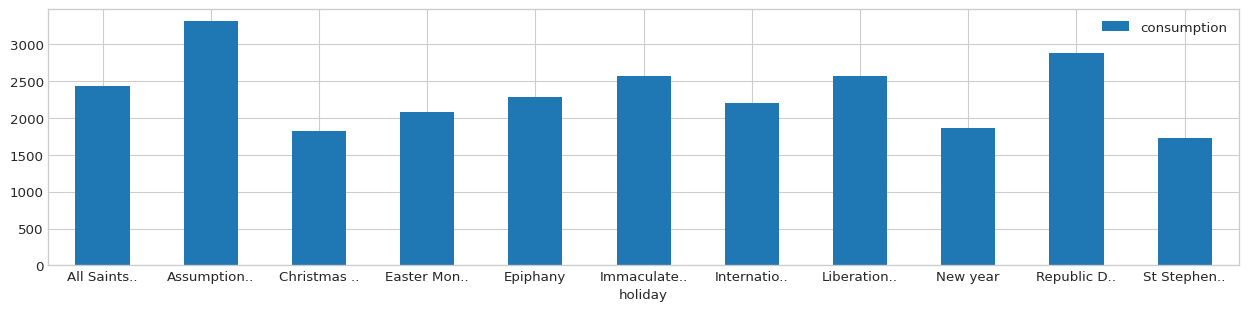
Next, let’s suppose that we want to lump together all holidays into only two (2) categories. Maybe, for instance, we want to fit a model that predicts energy consumption, but we only have data for one year, and hence not enough information to be confident about the impact of each individual holiday.
We can examine how the target (consumption) changes for each holiday value:
[11]:
to_group = data.loc[data['holiday'] != '_novalue_', ['consumption', 'holiday']]
grouped_mean = to_group.groupby('holiday').mean()

original_idx = grouped_mean.index
[12]:
grouped_mean.index = grouped_mean.index.map(lambda x: (x[:10] + '..') if len(x) > 10 else x)

with plt.style.context('seaborn-whitegrid'):
    fig = plt.figure(figsize=(16, 3.54), dpi=96)
    layout = (1, 1)
    ax = plt.subplot2grid(layout, (0, 0))

    grouped_mean.plot.bar(ax=ax, rot=0)
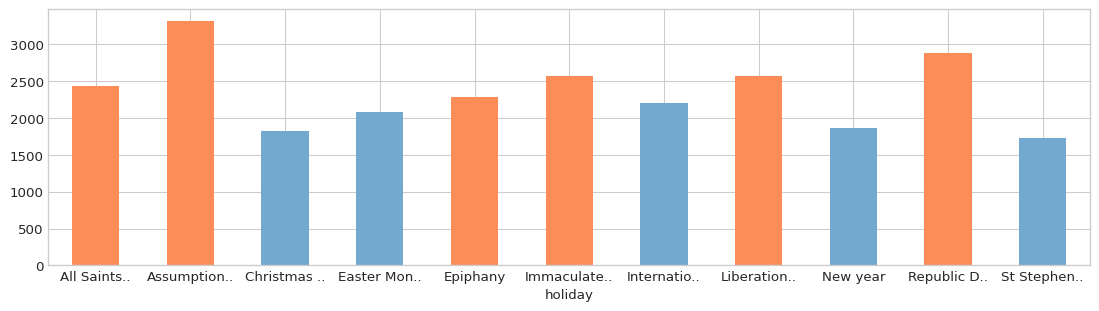
One approach could be to group holiday values together according to the different levels of the target:
[13]:
disc = KBinsDiscretizer(n_bins=2, encode='ordinal')
bins = disc.fit_transform(grouped_mean)
grouped_mean['bins'] = bins
[14]:
bin_values = [0, 1]
color_list = ['#74a9cf', '#fc8d59']
b2c = dict(zip(bin_values, color_list))

with plt.style.context('seaborn-whitegrid'):
    fig = plt.figure(figsize=(14, 3.54), dpi=96)
    layout = (1, 1)
    ax = plt.subplot2grid(layout, (0, 0))

    grouped_mean['consumption'].plot.bar(ax=ax, rot=0,
                                         color=[b2c[i] for i in grouped_mean['bins']])
We can plot the distribution of the consumption values for each category:
[15]:
mapping = pd.Series(data=grouped_mean['bins'].values, index=original_idx).to_dict()
data['bins'] = data['holiday'].map(lambda x: mapping.get(x))

with plt.style.context('seaborn-whitegrid'):
    fig = plt.figure(figsize=(16, 3.54), dpi=96)
    layout = (1, 2)
    ax0 = plt.subplot2grid(layout, (0, 0))
    ax1 = plt.subplot2grid(layout, (0, 1))

    subset = data[data['bins'] == 0]
    colors = get_colors('tab10', N=subset['holiday'].nunique())

    for i, (holiday, grouped) in enumerate(subset.groupby('holiday')):
        grouped['consumption'].plot.kde(ax=ax0, color=colors[i], bw_method=0.5)

    subset = data[data['bins'] == 1]
    colors = get_colors('tab10', N=subset['holiday'].nunique())

    for i, (holiday, grouped) in enumerate(subset.groupby('holiday')):
        grouped['consumption'].plot.kde(ax=ax1, color=colors[i], bw_method=0.5)
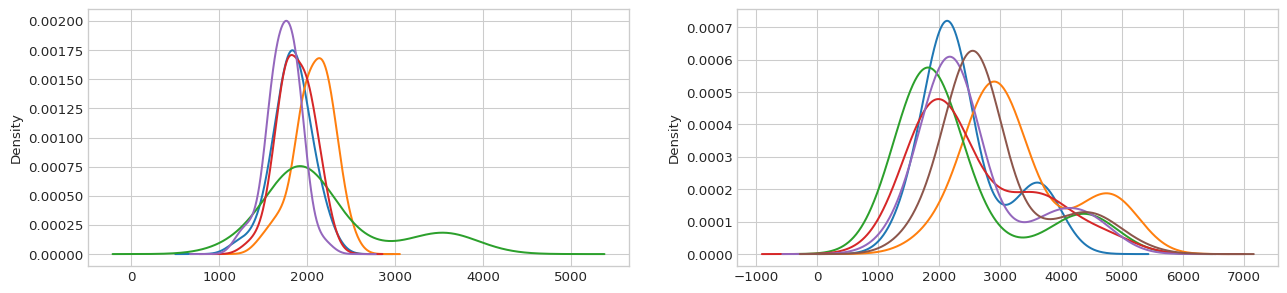
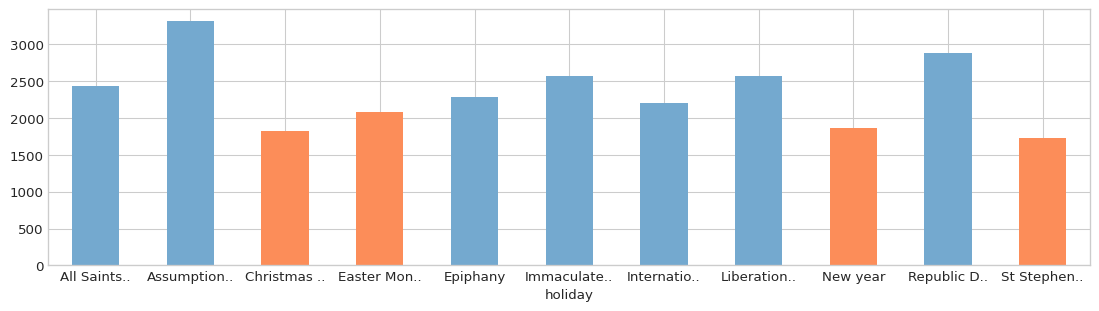
Going one step further, we could examine not only the mean of the target per holiday value but also other characteristics of its distribution. To take more aspects of the target’s distribution into account, the TargetClusterEncoder clusters the different values of a categorical feature according to the mean, standard deviation, skewness and the Wasserstein distance between the distribution of
the corresponding target’s values and the distribution of all target’s values (used as reference).
[16]:
enc = TargetClusterEncoder(
        feature='holiday',
        max_n_categories=2,
        excluded_categories='_novalue_'
)

X = data[['holiday']]
y = data['consumption']
enc = enc.fit(X, y)
We can update the bins column based on the encoder’s mapping between values of holiday and clusters:
[17]:
grouped_mean['bins'] = original_idx.map(lambda x: enc.mapping_[x])
… and plot the new features again:
[18]:
bin_values = [0, 1]
color_list = ['#74a9cf', '#fc8d59']
b2c = dict(zip(bin_values, color_list))

with plt.style.context('seaborn-whitegrid'):
    fig = plt.figure(figsize=(14, 3.54), dpi=96)
    layout = (1, 1)
    ax = plt.subplot2grid(layout, (0, 0))

    grouped_mean['consumption'].plot.bar(
        ax=ax,
        rot=0,
        color=[b2c[i] for i in grouped_mean['bins']]
    )
Again, we can plot the target distributions for each category to see what was achieved:
[19]:
data['bins'] = data['holiday'].map(lambda x: enc.mapping_.get(x))

with plt.style.context('seaborn-whitegrid'):
    fig = plt.figure(figsize=(16, 3.54), dpi=96)
    layout = (1, 2)
    ax0 = plt.subplot2grid(layout, (0, 0))
    ax1 = plt.subplot2grid(layout, (0, 1))

    subset = data[data['bins'] == 0]
    colors = get_colors('tab10', N=subset['holiday'].nunique())

    for i, (holiday, grouped) in enumerate(subset.groupby('holiday')):
        grouped['consumption'].plot.kde(ax=ax0, color=colors[i], bw_method=0.5)

    subset = data[data['bins'] == 1]
    colors = get_colors('tab10', N=subset['holiday'].nunique())

    for i, (holiday, grouped) in enumerate(subset.groupby('holiday')):
        grouped['consumption'].plot.kde(ax=ax1, color=colors[i], bw_method=0.5)
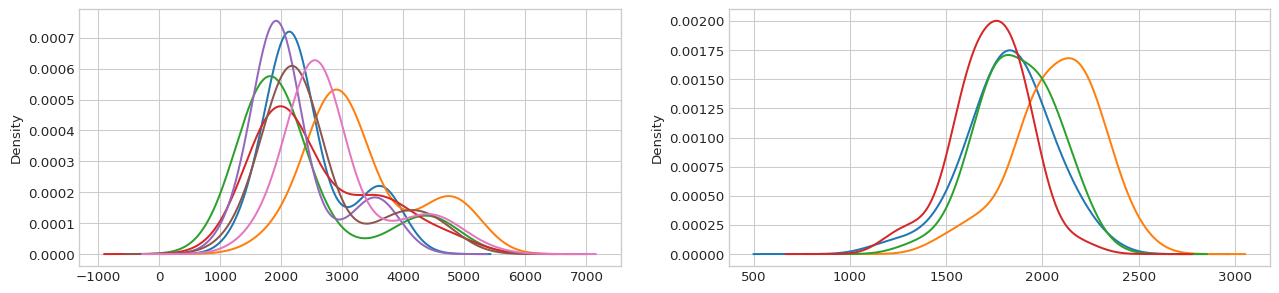
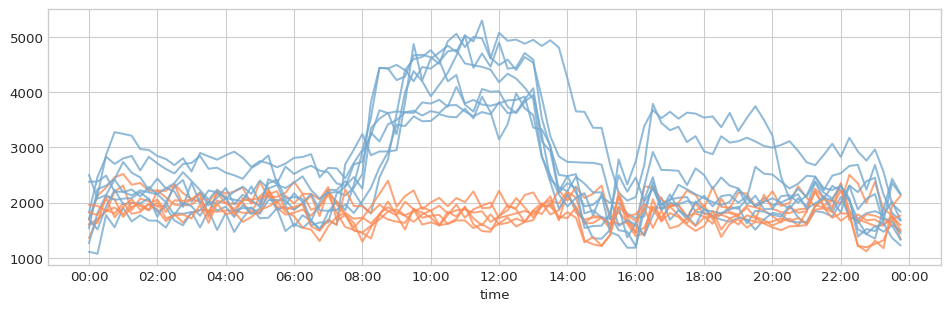
Not only the two clusters seem more homogeneous with respect to the distributions they include, but we also managed to distinguish the holidays according to their consumption profiles:
[20]:
profiles = data.loc[
                data['holiday'] != '_novalue_', ['consumption', 'holiday', 'bins']
           ].copy()
profiles['date'] = profiles.index.date
profiles['time'] = profiles.index.time

with plt.style.context('seaborn-whitegrid'):
    fig = plt.figure(figsize=(12, 3.54), dpi=96)
    layout = (1, 1)
    ax = plt.subplot2grid(layout, (0, 0))

    profiles.pivot(index='time', columns='date', values='consumption').plot(
        ax=ax,
        alpha=0.8,
        legend=None,
        color=[b2c[i] for i in profiles['bins'].resample('D').first().dropna()]
    )
    ax.xaxis.set_major_locator(ticker.MultipleLocator(3600*2))
Conditional effect on target
One may be explicitly interested in clustering the holiday feature taking into account the hour-of-day feature: how similar are the target’s values in two distinct values of holiday given similar values for the hour-of-day?
In this case, the encoder first stratifies the categorical feature holiday into groups with similar values of hour-of-day, and then examines the relationship between the categorical feature’s values and the corresponding values of the target.
The stratification is carried out by a sklearn.tree.DecisionTreeRegressor model that first fits the stratify_by features (here hour-of-day) on the target values, and then uses the tree’s leaf nodes as groups. Only the mean of the target’s values per group is taken into account when deriving the clusters.
The parameter min_samples_leaf defines the minimum number of samples required to be at a leaf node of the decision tree model. Note that the actual number that will be passed to the tree model is min_samples_leaf multiplied by the number of unique values in the categorical feature to transform.
[21]:
enc = TargetClusterEncoder(
        feature='holiday',
        max_n_categories=2,
        excluded_categories='_novalue_',
        stratify_by='hour',
        min_samples_leaf=5
)
[22]:
data['hour'] = data.index.hour

X = data[['holiday', 'hour']]
y = data['consumption']
enc = enc.fit(X, y)
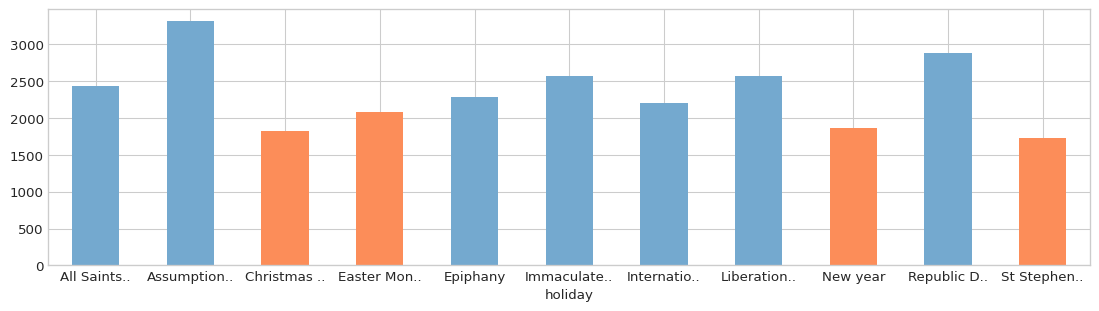
It is easy to understand the result of this operation if we consider that when the encoder groups holidays stratified by hours, it actually tries to group the daily profiles of the different holidays in the dataset. Since we already achieved this in the previous step, there shouldn’t be any change in the way holidays are grouped:
[23]:
grouped_mean['bins'] = original_idx.map(lambda x: enc.mapping_[x])

with plt.style.context('seaborn-whitegrid'):
    fig = plt.figure(figsize=(14, 3.54), dpi=96)
    layout = (1, 1)
    ax = plt.subplot2grid(layout, (0, 0))

    grouped_mean['consumption'].plot.bar(
        ax=ax,
        rot=0,
        color=[b2c[i] for i in grouped_mean['bins']]
    )
CategoricalEncoder
The CategoricalEncoder encodes a categorical feature by encaptulating all the aforementioned categorical encoders so far. If max_n_categories is not None and the number of unique values of the categorical feature is larger than the max_n_categories minus the excluded_categories, the TargetClusterEncoder will be called.
If encode_as = 'onehot', the result comes from a TargetClusterEncoder + SafeOneHotEncoder pipeline, otherwise from a TargetClusterEncoder + SafeOrdinalEncoder one:
n_categories = X[self.feature].nunique()
use_target = (self.max_n_categories is not None) and (
    n_categories - len(self.excluded_categories_) > self.max_n_categories
)

if not use_target:
    self.feature_pipeline_ = Pipeline(
        [
            (
                "encode_features",
                SafeOneHotEncoder(
                    feature=self.feature, unknown_value=self.unknown_value
                ),
            )
            if self.encode_as == "onehot"
            else (
                "encode_features",
                SafeOrdinalEncoder(
                    feature=self.feature, unknown_value=self.unknown_value
                ),
            )
        ]
    )
else:
    self.feature_pipeline_ = Pipeline(
        [
            (
                "reduce_dimension",
                TargetClusterEncoder(
                    feature=self.feature,
                    stratify_by=self.stratify_by,
                    max_n_categories=self.max_n_categories,
                    excluded_categories=self.excluded_categories,
                    unknown_value=self.unknown_value,
                    min_samples_leaf=self.min_samples_leaf,
                    max_features=self.max_features,
                    random_state=self.random_state,
                ),
            ),
            (
                "to_pandas",
                FunctionTransformer(self._to_pandas),
            ),
            (
                "encode_features",
                SafeOneHotEncoder(
                    feature=self.feature, unknown_value=self.unknown_value
                ),
            )
            if self.encode_as == "onehot"
            else (
                "encode_features",
                SafeOrdinalEncoder(
                    feature=self.feature, unknown_value=self.unknown_value
                ),
            ),
        ]
    )
[24]:
max_n_categories = data['holiday'].nunique() + 3
[25]:
enc = CategoricalEncoder(feature='holiday',
                         max_n_categories=max_n_categories,
                         encode_as='onehot')

features = enc.fit_transform(X, y)
features[:5]
[25]:
array([[0., 0., 0., 0., 0., 0., 0., 0., 0., 0., 0., 1.],
       [0., 0., 0., 0., 0., 0., 0., 0., 0., 0., 0., 1.],
       [0., 0., 0., 0., 0., 0., 0., 0., 0., 0., 0., 1.],
       [0., 0., 0., 0., 0., 0., 0., 0., 0., 0., 0., 1.],
       [0., 0., 0., 0., 0., 0., 0., 0., 0., 0., 0., 1.]])
[26]:
assert min(data['holiday'].nunique(), max_n_categories) == enc.n_features_out_
[27]:
enc = CategoricalEncoder(feature='holiday',
                         max_n_categories=max_n_categories,
                         encode_as='ordinal')

features = enc.fit_transform(X, y)
features[:5]
[27]:
array([[11],
       [11],
       [11],
       [11],
       [11]], dtype=int16)
[28]:
assert min(data['holiday'].nunique(), max_n_categories) == np.unique(features).size
[29]:
max_n_categories = data['holiday'].nunique() - 3
[30]:
enc = CategoricalEncoder(feature='holiday',
                         max_n_categories=max_n_categories,
                         encode_as='onehot')

features = enc.fit_transform(X, y)
features[:5]
[30]:
array([[0., 0., 0., 0., 1., 0., 0., 0., 0.],
       [0., 0., 0., 0., 1., 0., 0., 0., 0.],
       [0., 0., 0., 0., 1., 0., 0., 0., 0.],
       [0., 0., 0., 0., 1., 0., 0., 0., 0.],
       [0., 0., 0., 0., 1., 0., 0., 0., 0.]])
[31]:
assert min(data['holiday'].nunique(), max_n_categories) == enc.n_features_out_
[32]:
enc = CategoricalEncoder(feature='holiday',
                         max_n_categories=max_n_categories,
                         encode_as='ordinal')

features = enc.fit_transform(X, y)
features[:5]
[32]:
array([[5],
       [5],
       [5],
       [5],
       [5]], dtype=int16)
[33]:
assert min(data['holiday'].nunique(), max_n_categories) == np.unique(features).size
An application of the categorical encoder
Suppose we want to use the demo data to predict the energy consumption of the building. The simplest model to use is a model that includes only the hour of the week as a feature. The hour of the week is a categorical feature and it can be encoded in one-hot form:
[34]:
data['hourofweek'] = 24 * data.index.dayofweek + data.index.hour
dmatrix = CategoricalEncoder(feature='hourofweek', encode_as='onehot').fit_transform(data)
We can fit a linear model:
[35]:
model = LinearRegression(fit_intercept=False).fit(dmatrix, y)
… and evaluate it in-sample:
[36]:
pred = model.predict(dmatrix)
[37]:
print(f"In-sample CV(RMSE) (%): {100*mean_squared_error(y, pred, squared=False)/y.mean()}")
In-sample CV(RMSE) (%): 19.332298975680697
The degrees of freedom of the model are:
[38]:
np.linalg.matrix_rank(dmatrix)
[38]:
168
We can ask the CategoricalEncoder to lump together the 168 hour-of-week values into only 60, and repeat the process:
[39]:
X = data[['hourofweek']]
y = data['consumption']

dmatrix = CategoricalEncoder(
                feature='hourofweek',
                encode_as='onehot',
                max_n_categories=60
          ).fit_transform(X, y)

model = LinearRegression(fit_intercept=False).fit(dmatrix, y)
pred = model.predict(dmatrix)

print(f"In-sample CV(RMSE) (%): {100*mean_squared_error(y, pred, squared=False)/y.mean()}")
In-sample CV(RMSE) (%): 19.349420155191982
This is practically the same performance with one third of the degrees of freedom:
[40]:
np.linalg.matrix_rank(dmatrix)
[40]:
60